The Quiet Skill of Keeping Old Tech Alive in 2026
By Maya Patel · 2026-03-22 · 7 min read

There is a small advert in the window of a hardware shop near where I grew up in north Manchester. It is hand-lettered, looks at least fifteen years old, and reads simply: "Television and Radio Repairs. Reasonable Rates. Call in person." The shop is still open. The man inside still does the repairs. And he is, gently, an example of a quiet skill that the rest of the country is, just as quietly, learning to value again.
The decade of replace
For most of the last fifteen years the British high street story has been the same one: the small repair shop closed, the chain electrical retailer expanded, and the household behaviour shifted. A microwave broke; we bought a microwave. A kettle stopped boiling; we bought a kettle. A television lost its picture; we did the maths on the back of an envelope and bought a television. None of this was unreasonable. New goods became cheaper in real terms; old goods became harder to repair as manufacturers moved to sealed units; the engineer down the road retired without an apprentice.
But underneath the replace-rather-than-repair decade, a few things have changed. New goods have become cheaper but not as quickly as they used to. Sealed units have, in a few categories, been pried back open by community pressure and right-to-repair legislation. And households have, gradually, noticed something that the back-of-envelope sum did not capture: that a working appliance, kept working, is a different kind of object from a brand-new one. It is yours. It fits the corner where it lives. It is on a shelf you do not really want to rearrange.
What the engineers know
The engineers who kept this skill alive through the lean decade are not a romantic profession. Most of them are practical people in middle age who learned the trade in workshops, on training courses, or through long apprenticeships in factories that no longer exist. They tend to keep careful notes. They tend to drive small reliable vans. They tend to be slightly bemused when a new customer treats the home visit as if it were unusual, because to them it is simply Tuesday.
What they know, collectively, is that most electrical failures in British homes fall into a manageable number of categories. A burnt-out capacitor on a television power board. A scaled-up element on a kettle. A clogged printer head. A failed thermostat on a washing machine. Each of these can be diagnosed in minutes by someone who has seen it five hundred times. Each can usually be repaired for a fraction of the price of a replacement. And each repair, done properly, lasts.
The slow return of repair
There is no single reason the small repair sector is gently doing better than it was. Several modest forces have lined up at once.
The right-to-repair regulation that came into force in the UK in 2021 — applying initially to televisions, washing machines, dishwashers and refrigerators — required manufacturers to make spare parts available for several years after a model goes out of production. This did not single-handedly revive the repair trade, but it removed a significant practical barrier.
Energy prices began to rise, and the unwritten arithmetic of British households shifted. A working appliance kept in service is, by definition, more energy-efficient than a manufactured replacement, even when the new model is rated higher on the energy label. The carbon and pounds of buying a new washing machine are not erased by it running on slightly less electricity.
Generations changed. Younger British households — those in their twenties and thirties now — have, in surveys, shown more interest in repair than the generations immediately before them. This is sometimes attributed to environmental concern, but the more honest explanation is probably that things are now expensive enough that the calculation has changed.
And reputation travelled. Engineers who do the work well are passed around groups of neighbours, group chats of friends, parents at the school gate. A good repair person in a British town quickly acquires a small waiting list.
What it looks like in a living room
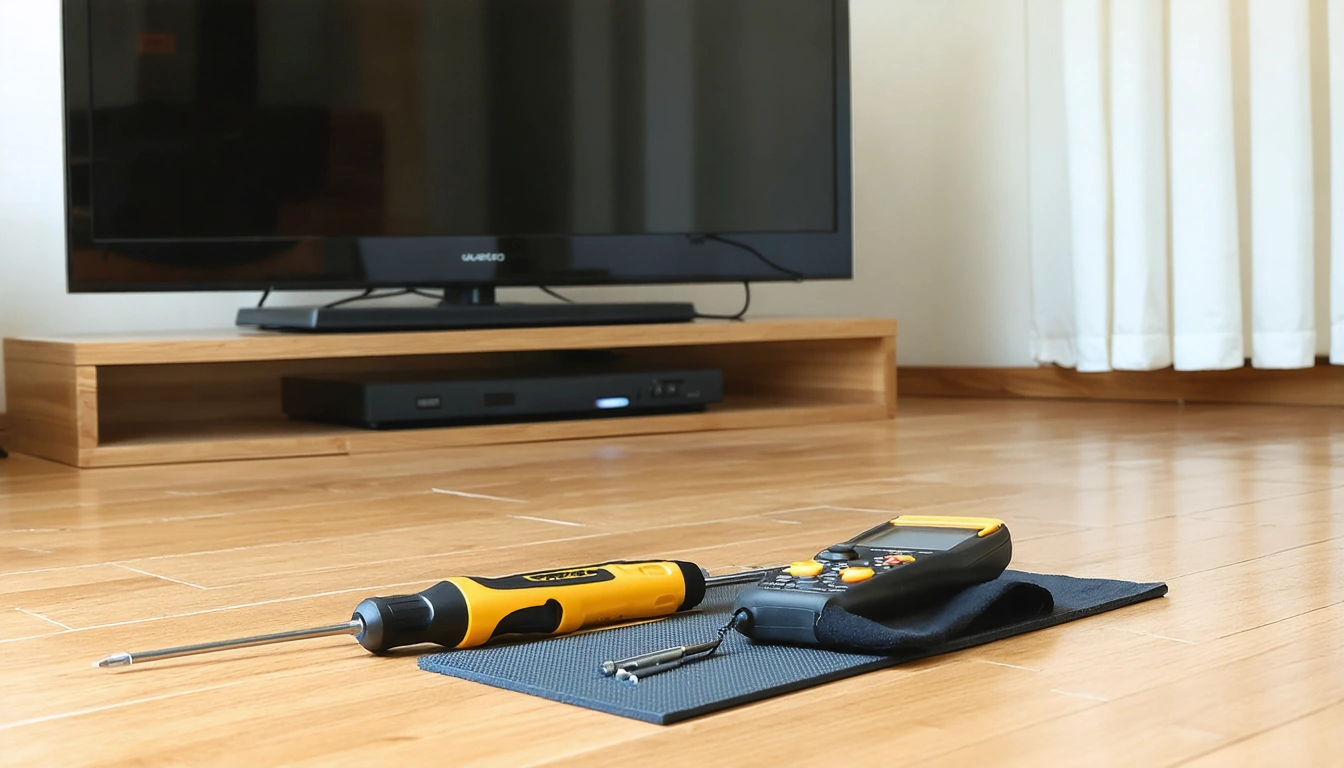
The visible part of all this, in a typical British home, is small and undramatic. A television that switched off in the middle of a Sunday afternoon is sitting on again on Wednesday evening. A washing machine that flashed an error code on Saturday is humming through a normal cycle on Monday. A printer that had been silent on the shelf for three months is, after a visit, working well enough to print a year's worth of tax documents.
What changes is not really the appliance. It is the relationship the household has with the appliance. Once a thing has been repaired, it stops being a candidate for replacement. It becomes part of the furniture, with the rest of the things that get to stay because they work.
The cost of letting it disappear
It is worth saying plainly what is at risk if the repair trade quietly disappears in the next decade. It is not nostalgia. It is the practical fact that a country in which everything broken must be replaced is a more expensive country to live in than one in which most broken things can be fixed. It is also a slightly noisier, more wasteful, slightly more anxious country, because households cannot rely on the small craft that turns a malfunction into a phone call.
The British repair sector is small but durable. It survives on word of mouth and on the quiet competence of the people in it. Keeping it alive — by calling someone before you write the appliance off, by recommending a good engineer when a neighbour asks, by paying the labour fairly — is one of the more modest civic things a household can do.
The man in the hardware-shop window in north Manchester does not, of course, frame his trade in those terms. He just does the repairs.
Editorial standards: this article reflects general consumer guidance for UK readers. We do not provide medical, legal, or financial advice. For specific matters please consult a qualified professional.
Related reading
 Tech
TechWhat a Reputable TV Engineer Actually Does in Your Home
A walk-through of what to expect when a UK television engineer visits — from the doorstep to the cabinet being closed.
 Home
HomeRepair or Replace? A Plain-English Calculator for British Households
When a television fault is worth fixing and when it is not, written for the UK living room without industry jargon or exact prices.
 Culture
British Sitcoms That Outlived Their Decade — And Why
What the long-runners of British sitcom can tell us about writing, performance, and the small architecture of a half-hour comedy.